
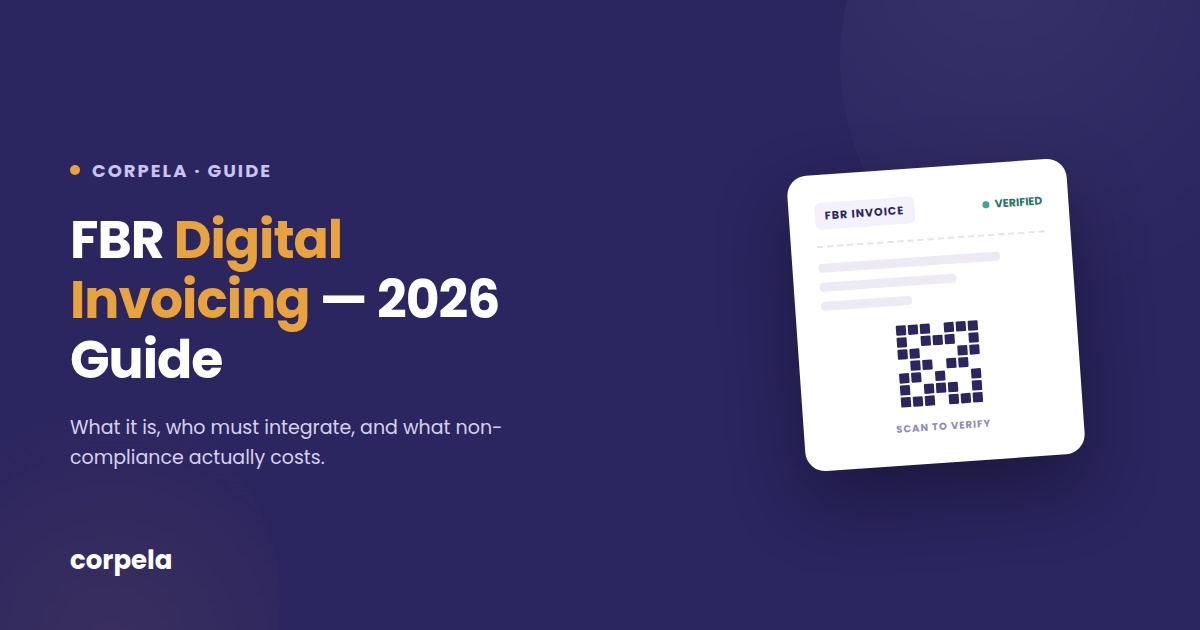
FBR Digital Invoicing: What Every Pakistani Business Needs to Know in 2026
If you run a business in Pakistan and you're still treating FBR digital invoicing as something to figure out "later," it's worth pausing on that. For a growing list of businesses, later has already arrived — and the cost of waiting is climbing.
Here's what digital invoicing actually is, who it applies to right now, and what it means for how you run your business.
What FBR digital invoicing actually is
FBR digital invoicing is a real-time link between your business and the Federal Board of Revenue. Instead of reporting your sales once a month through a sales tax return, your point-of-sale system, ERP, or billing software connects directly to FBR's system and reports each sale as it happens.
Every compliant invoice carries two things: a unique invoice number issued by FBR before the sale is complete, and a QR code that lets anyone — a customer, your accountant, or FBR itself — verify the invoice instantly. It's the difference between a paper trail assembled at month-end and a live, verifiable record of every transaction.
The motivation behind it is straightforward. Before this system, invoices could be backdated, duplicated, or simply never issued, and that gap cost Pakistan a significant amount in lost tax revenue every year. Digital invoicing closes that gap by making every sale visible in real time.
Who needs to integrate right now
FBR has rolled this out in phases, organized by business size and sector rather than all at once. As of 2026, the categories required to integrate include:
Large-scale manufacturers producing goods for distributors, wholesalers, or retailers
- FMCG distributors and wholesalers in fast-moving consumer goods supply chains
- Tier-1 retailers connected through FBR's POS integration system
- Importers and exporters handling cross-border trade
- Sales-tax registered service providers, depending on sector and turnover
If your business falls into one of these categories, the deadline isn't a distant formality — FBR has already begun enforcing penalties for businesses that missed their integration windows, and enforcement is only getting stricter through 2026.
The advantages, if you do it right
Digital invoicing isn't purely a compliance burden. Done properly, it changes how your business actually operates:
Fewer fake or duplicate invoices. Since every invoice is verified centrally, the fraud that used to slip through manual systems has nowhere to hide.
Faster, cleaner input tax processing. Because your sales are already documented in real time, filing your returns becomes a matter of exporting accurate numbers instead of reconstructing a month of paperwork.
Fewer manual errors and lower audit risk. Structured, validated invoices catch mistakes before they become a problem during an audit.
Trust with compliance-conscious buyers. Larger clients and government bodies increasingly prefer — or require — suppliers who are fully compliant.
Real-time visibility into your own numbers. You get a live view of your sales, not a rearview mirror once a month.
The disadvantages, if you're not ready
The friction mostly comes from businesses trying to retrofit systems that were never built for Pakistan's tax structure.
Most global accounting and ERP platforms — the ones built for international markets — don't support Pakistan's tax rules out of the box. Business owners often assume their existing software will "just work" with FBR, only to discover it can't produce a structured, FBR-compliant invoice at all. Integration takes real setup time: registering your business and outlets, testing your system, and connecting through a licensed integrator — not a plug-and-play toggle.
The bigger risk is what happens if you skip it. Invoices issued outside the FBR system are legally invalid. That doesn't just affect you — it invalidates your customer's input tax claim too, which can quietly damage business relationships with buyers who need clean, compliant paperwork from their suppliers.
What non-compliance actually costs
The penalties are not symbolic. Under the Sales Tax Act, 1990, non-compliance can carry fines running into the hundreds of thousands of rupees per violation, and repeated violations can escalate to sales tax audits or even sealing of business premises.
FBR has also expanded its enforcement capacity significantly in 2026, adding hundreds of new auditors specifically to monitor compliance with digital invoicing. The businesses that treat this as optional are the ones most likely to get caught by that expanded enforcement.
Where this leaves your business
Digital invoicing has moved from "something FBR is piloting" to "the standard way of doing business in Pakistan." The businesses integrating early are avoiding the scramble, the penalties, and the awkward conversations with buyers about invalid invoices. The businesses waiting are stacking up risk with every sale they make outside the system.
If you're not sure whether your business is required to integrate yet, or you're unsure how to connect your existing POS or accounting system to FBR without disrupting daily operations, that's exactly the kind of problem worth solving before a deadline forces the issue.
Not sure where your business stands with FBR digital invoicing? Corpela builds FBR-compliant invoicing systems built for how Pakistani businesses actually operate. Get in touch and we'll walk you through it.
This article is for general informational purposes and isn't tax or legal advice. FBR deadlines and penalties are updated periodically — always confirm current requirements on fbr.gov.pk or with a qualified tax advisor.